SARE
ARYA PARIWARS KO
VAISAKHI KI SHUB
KAMNAYE.
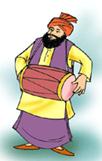
Baisakhi marks the beginning of New Year, particularly in the northern
part of India. It is among the few Indian festivals that have a fixed date. Baisakhi is always on April 13th. It is on this day that
Sun enters Aries, the first sign of Zodiac. This signifies ushering of the New
Year in Hindu calender.
In Northern India, sepecially in Punjab
farmers perform their own prayers and give ‘thanks’ to the Lord Almighty for
their fortune and pray for a better crop the next year. On this day, they
commence reaping their harvest. The fields can be seen full of nature’s bounty.
For the Sikhs the day is a collective celebration of New Year
along with the commemoration of the founding of the Khalsa
Panth (Sikh brotherhood) by Guru Gobind
Singh in 1699. Dressed in their
typical folk attire, both men and women, celebrate the day with Bhangra and Gidda.
The above two are the main reasons for celebrating Baisakhi.
But let us no forget
a historic event which took place on Vaisakhi day of April 13 1919,
The Amritsar massacre, also known as the Jallianwala
Bagh massacre,
when British Army of
(Pathan, Baluch and Gurkha)led by a Brig-Gen. Reginald Dyer
without warning opened fire on
an unarmed innocent gathering, killing
men, women and children.
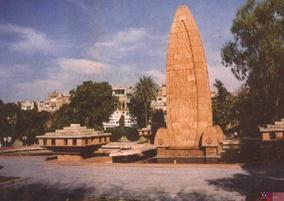
JALIANWALA BAHG MASSECAR
MEMORIAL
The words Jallianwala Bagh, has a hypnotic effect on the Indian mind. It brings
forth unadulterated feelings of patriotism on the one hand and utter contempt of the British Raj on the other hand. We have
to remind over selves and others especially the younger generation of today of
those hard days when British imperialists would go to any extent to strengthen
their hold on India.
The bloody and the most ghastly event of Jallianwala Bagh in
Amritsar took place on the Vaisakhi
day on April 13th 1919, when
thousands of people from all over India, gathered in the Jallianwala
Bagh near Golden Temple in Amritsar to celebrate a more
than two hundred years old annual festival,
for the new harvest and Sikh religious new year. Jallianwala
Bagh, as such, is an immortal milestone in India’s struggle for freedom.
It stands as a beacon of light of inspiration to all of us and
which laid the foundation of freedom of India, with their blood and let us pay
our humble homage to the people who embraced death so that the nation may live.
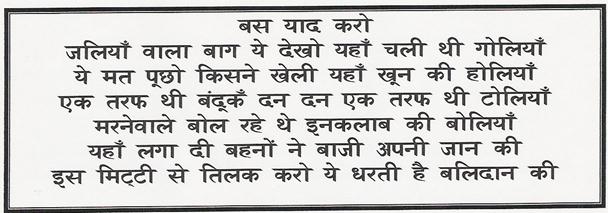
Just remember
Jallianwala Bagh yeh dekho, Yahan
chali thhi goliyan,
Yeh mat puchho kisne kheli yahan
khoon ki holian.
Ek taraf thee bandook dandan
ek taraf thi tolian.
Marne waale bol rahe thhe,
Inquilab ki boliyan.’
Yahaan lagaa dii bahano ne bhii baaji apani
jaan kii.
Is mittie se tilak karo ye dharti ha balidhan ki.
The
Disorder Inquiry Committee known as Hunter Committee after its chairman, Lord
Hunter, held Brigadier-General R.E.H. Dyer guilty of a mistaken notion of duty,
and he was relieved of his command and prematurely retired from the army. The
Indian National Congress at its annual session in December 1919 at Amritsar India
On 13 March
1940 after 21 years an Indian
revolutionary named Udham Singh, who had witnessed the events in
Amritsar and was himself wounded, shot dead Sir Michael
O'Dwyer, the tehn Governor of Punjab, believed to be the chief
planner of the massacre at the Caxton Hall in London. (Gen.Dyer
having died years earlier in 1927)
Udham Singh had told the court at his trial: "I did
it because I had a grudge against him. He deserved it. He was the real culprit.
He wanted to crush the spirit of my people, so I have crushed him. For full 21
years, I have been trying to wreak vengeance. I am happy that I have done the
job. I am not scared of death. I am dying for my country. I have seen my people
starving in India under the British rule. I have protested against this, it was
my duty. What a greater honour could be bestowed on me than death for the sake
of my motherland?"
Udham Singh was hanged for the murder on
But earlier in March 1940, many, including
Nehru and Mahatma Gandhi, had condemned the action of Udham
as senseless.
The
Arya Samaj and such other organizations should always remind people to
celebrate the anniversaries of such incidents lest we should forget our
national heroes and martyrs.
The massacre
was the worst atrocity by a British officer ever recorded.
By Kewal Ahluwalia.